
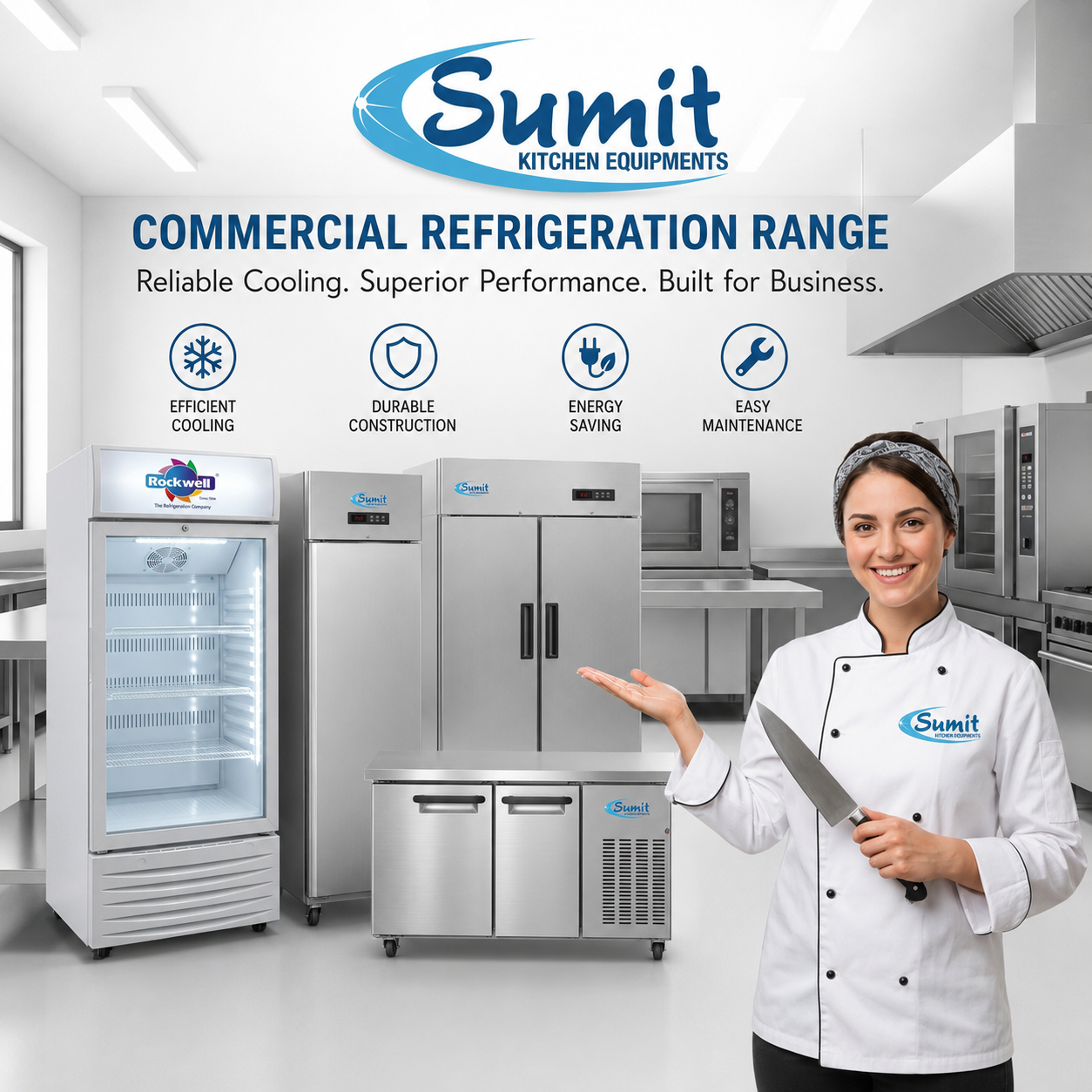
Walk into any professional kitchen — a restaurant, a hotel, a bakery, or a hospital canteen — and you will find one category of equipment that runs without pause, 24 hours a day, 7 days a week, 365 days a year. Not the cooking range. Not the prep tables. The refrigeration.
Commercial refrigeration is the silent backbone of every successful food business. It keeps your ingredients fresh, your food safe, your waste low, and your compliance with food safety regulations intact. Yet despite its critical importance, refrigeration is one of the most under-researched purchases that food business owners make. Many simply buy the cheapest unit available, or copy what they saw in another kitchen, without understanding whether it is the right solution for their specific needs.
The result is predictable — a refrigerator that cannot maintain consistent temperature under commercial load, breaks down during the hottest months, drives up electricity bills, or simply fails to pass a food safety inspection.
This guide changes that. Whether you are setting up your first restaurant, upgrading an existing kitchen, or expanding to a second location, here is everything you need to know about commercial refrigeration — what types are available, what to look for, and how to choose the right combination for your specific business.
Why Commercial Refrigeration Is Different from Domestic Refrigeration
Before diving into types and specifications, it is important to understand why you cannot — and should not — use domestic refrigerators in a commercial food environment.
A domestic refrigerator is designed for one household. It is opened perhaps 10 to 15 times a day, stores a modest quantity of food, and operates in a temperature-controlled home environment. It is built to last 8 to 10 years under these relatively gentle conditions.
A commercial refrigerator operates in an entirely different world. In a busy restaurant kitchen, a refrigerator may be opened 100 to 200 times during a single service. It must maintain precise temperatures despite the heat generated by nearby cooking equipment. It stores large volumes of ingredients that are constantly being added and removed. And it must do all of this reliably, day after day, without failure — because a refrigerator breakdown in a commercial kitchen means spoiled stock, food safety violations, and lost revenue.
Commercial refrigeration units are engineered specifically for these demands. They have more powerful compressors, better insulation, faster temperature recovery after the door is opened, and construction quality designed for a commercial lifespan of 10 to 15 years or more.
Cutting corners on refrigeration is one of the most expensive mistakes a food business owner can make.
The Main Types of Commercial Refrigeration
Commercial refrigeration comes in several distinct formats, each designed for a specific function. Understanding what each type does — and what it is not designed for — is the first step to making the right choice.
1. Upright Single Door Refrigerator
The single door upright refrigerator is one of the most versatile units in commercial refrigeration. It is a tall, vertical unit with a solid stainless steel door, designed to store a large volume of ingredients in a relatively compact footprint.
Best for:
- Small to mid-sized restaurants
- Cloud kitchens with a focused menu
- Bakeries and sweet shops needing back-of-house cold storage
- Any kitchen where floor space is limited but cold storage volume is important
What to look for:
- Digital temperature control for precise settings
- Stainless steel interior — easy to clean and hygienic
- Adequate shelving with adjustable configurations
- Strong door seals that maintain temperature even with frequent opening
- A compressor powerful enough to recover temperature quickly after the door is opened
A single door upright unit is typically the starting point for cold storage in smaller operations and serves as a supplementary unit in larger ones.
2. Double Door Upright Refrigerator
The double door upright refrigerator is the workhorse of hotel kitchens, large restaurants, hospital canteens, and catering operations. It offers significantly more storage capacity than a single door unit while maintaining a manageable footprint.
Best for:
- Hotels and banquet kitchens
- Restaurants serving 100+ covers per day
- Hospital and institutional kitchens
- Catering businesses with large ingredient volumes
What to look for:
- Independent temperature zones for each door — allowing different sections to be set at different temperatures
- Heavy-duty hinges and door seals designed for constant use
- Full stainless steel construction — inside and out
- Digital temperature display and alarm system to alert staff if temperature rises above safe levels
- Adequate interior lighting for easy identification of stored items
The double door unit from Sumit Kitchen Equipments is built with food-grade stainless steel throughout, digital temperature control, and puff insulation for superior temperature retention — making it one of the most reliable options for high-volume kitchens.
Explore the complete Cold Equipments range to compare single and double door configurations.
3. Under Counter Refrigerator
The under counter refrigerator is a compact, low-profile unit designed to fit beneath a work counter — making it one of the most space-efficient cold storage solutions available. In kitchens where every square foot of floor space matters, an under counter refrigerator keeps ingredients within arm’s reach of the chef without taking up valuable standing room.
Best for:
- Busy restaurant kitchens with limited floor space
- Bar setups needing chilled beverage and garnish storage
- Pizza and sandwich stations where ingredients need to be immediately accessible
- Any kitchen section that needs cold storage at the point of use
What to look for:
- Wheels or casters for easy repositioning during cleaning
- Top surface constructed from stainless steel — so the top of the unit doubles as a work surface
- Digital temperature control and consistent cooling performance
- Adequate internal capacity for the volume of ingredients used at that station
The under counter refrigerator pairs beautifully with Casual Counters and working tables, creating an integrated, ergonomic workspace where cold storage and prep happen in the same zone.
4. Glass Door Display Refrigerator
The glass door display refrigerator serves a dual purpose that makes it uniquely valuable in certain food business settings — it stores products at the correct temperature while simultaneously showcasing them to customers.
Unlike the back-of-house refrigerators described above, the glass door display unit is designed to face customers. It is common in:
- Beverage shops and juice bars
- Bakeries and patisseries displaying chilled desserts
- Sweet shops with dairy-based products
- Ice cream parlours and dessert cafés
- Hotels and restaurants with self-service beverage stations
What to look for:
- High-quality glass that offers a clear, undistorted view of the products inside
- Interior LED lighting that makes products look attractive without generating heat
- A consistent, uniform cooling system that maintains temperature throughout the cabinet — including near the glass, where heat transfer can be an issue
- Attractive exterior design — since this unit faces customers, its appearance contributes to your brand perception
- Easy-to-clean shelving that can be reconfigured to accommodate different product sizes
A well-chosen glass door display refrigerator is not just a storage unit — it is a sales tool. Products that are visible, well-lit, and attractively displayed sell more. This is particularly important for ice cream parlours and dessert businesses where the visual appeal of the display directly drives purchase decisions.
For parlour setups, pairing a glass door display refrigerator with a dedicated Ice Cream Parlour counter creates a complete, professional front-of-house display.
Key Specifications to Evaluate When Buying Commercial Refrigeration
Beyond the type of unit, there are several technical specifications that significantly affect the performance and value of commercial refrigeration. Here is what to look for and why it matters.
Temperature Range and Stability
Different food products require different storage temperatures. Fresh produce, dairy, and cooked food typically need to be stored between 1°C and 4°C. Frozen products require -18°C or below. Some units offer a temperature range that bridges both — but for serious commercial use, dedicated refrigeration and freezing units are more reliable than combination units.
More important than the stated temperature range is temperature stability — how consistently the unit maintains its set temperature under real operating conditions (frequent door opening, high ambient kitchen temperature, full load). Look for units with strong compressors and good puff insulation that recover temperature quickly after each door opening.
Insulation Quality
Insulation is the unsung hero of refrigeration performance. Good insulation reduces the work the compressor has to do to maintain temperature, which directly translates to lower electricity consumption and longer compressor life.
Puff insulation (also called PUF — polyurethane foam) is the industry standard for commercial refrigeration. It fills the walls, door, and ceiling of the cabinet, providing excellent thermal insulation. Always confirm that a commercial refrigerator uses puff insulation rather than cheaper alternatives.
Compressor Quality and Placement
The compressor is the heart of the refrigeration system. Its quality determines how reliably and efficiently the unit cools. Look for units with compressors from reputable manufacturers.
Top-mounted compressors are more common in commercial units because they keep the compressor away from the heat and debris at floor level, and make maintenance easier. Bottom-mounted compressors are common in under counter units where height is limited.
Stainless Steel Grade
As with all commercial kitchen equipment, the grade of stainless steel matters. Food-grade 304 stainless steel is the standard for commercial refrigeration interiors — it is non-reactive, non-porous, easy to sanitise, and resistant to the moisture and condensation inherent in a refrigeration environment.
The exterior construction also matters — particularly for units that face customers or are positioned in high-traffic kitchen areas. Full stainless steel exterior construction looks professional, resists dents and scratches, and is easy to wipe clean.
Digital Temperature Control and Monitoring
Manual temperature controls are unreliable in a commercial setting — they are difficult to set precisely and offer no way to verify actual cabinet temperature. Digital temperature control and display allows staff to set and monitor temperature precisely, and some units include alarm systems that alert staff if the temperature rises above a safe level — an early warning system that can prevent significant stock loss.
Common Refrigeration Mistakes Food Businesses Make
Understanding what not to do is as important as knowing what to do. Here are the most common refrigeration mistakes food business owners make — and how to avoid them.
Buying undersized units — A refrigerator that is too small for your volume will be constantly overpacked. Overpacking restricts airflow inside the cabinet, causing uneven cooling and forcing the compressor to work harder. Always buy slightly above your current capacity needs.
Ignoring ambient kitchen temperature — Commercial refrigerators are rated at a specific ambient temperature — typically 32°C to 38°C. In a hot Indian kitchen where cooking equipment generates significant heat, placing a refrigerator directly next to a cooking range can push the ambient temperature beyond the unit’s rated operating range, reducing performance and shortening compressor life. Ensure adequate ventilation and spacing around your refrigeration units.
Skipping preventive maintenance — Commercial refrigerators need periodic maintenance — coil cleaning, door seal inspection, and compressor checks. Neglecting this leads to gradual performance decline and unexpected failures. Build a maintenance schedule into your kitchen operations from day one.
Using a single large unit instead of multiple smaller ones — In a large kitchen, one large refrigerator serving the entire operation creates a single point of failure. If it breaks down, your entire cold storage is compromised. Multiple units — each serving a specific kitchen section — provide redundancy and make temperature management more precise.
Not planning for FSSAI compliance — Food safety regulations specify requirements for cold storage temperatures and monitoring. Ensure your refrigeration setup — including thermometers, temperature logs, and alarm systems — meets FSSAI standards before your inspection.
Planning Your Refrigeration Layout
Where you place your refrigeration units matters as much as which units you choose. A well-planned refrigeration layout reduces unnecessary movement in the kitchen, keeps ingredients close to where they are needed, and supports an efficient workflow.
Zone your kitchen — Match your refrigeration to your kitchen zones. Meat and fish storage near the protein prep area. Dairy and produce near the vegetable prep area. Ready-to-serve items near the pass. An under counter refrigerator at each key station keeps ingredients immediately accessible without staff having to cross the kitchen during service.
Allow ventilation space — Every refrigeration unit needs adequate clearance on the sides and top for ventilation. Blocked ventilation reduces efficiency and shortens compressor life. Check the manufacturer’s specifications for minimum clearance requirements.
Keep refrigeration away from heat sources — Position refrigerators away from cooking ranges, ovens, and fryers. The closer a refrigerator is to a heat source, the harder its compressor works. A metre or more of separation — or a physical divider — makes a significant difference.
Plan for cleaning access — Under counter units on wheels can be pulled out for cleaning beneath and behind them. Upright units should have enough clearance at the back for a cleaning brush to reach the condenser coils.
Refrigeration for Specific Business Types
Restaurant (50–150 covers): A combination of one double door upright refrigerator for main stock, one or two under counter units at key prep stations, and a glass door display chiller for beverages covers most needs.
Hotel or Banquet Kitchen: Multiple double door upright units organised by food category (meat, dairy, produce, cooked food), supplemented by under counter units at prep stations and a large walk-in cold room if volume justifies it.
Bakery: A single door upright for daily dairy and egg stock, a display chiller for finished products, and potentially a blast chiller for rapid cooling of baked goods before decoration.
Ice Cream Parlour: A glass door display freezer as the primary customer-facing unit, supplemented by back-of-house cold storage for bulk stock. Explore the complete Ice Cream Parlour setup range for integrated solutions.
Catering Business: Portable under counter units and upright refrigerators that can be transported to event venues, supported by adequate home-base cold storage for ingredient prep and storage.
Final Thoughts
Commercial refrigeration is not a purchase to rush or to cut corners on. It is the foundation of your food safety, your ingredient quality, and your kitchen’s ability to operate consistently day after day. The right refrigeration setup — matched to your business type, your volume, and your kitchen layout — will serve you reliably for a decade or more and pay for itself many times over through reduced wastage, lower electricity costs, and consistent food quality.
Whether you need a compact under counter refrigerator for a cloud kitchen, a high-capacity double door unit for a hotel kitchen, or an attractive glass door display chiller for your parlour or beverage outlet, the right solution is available for every budget and every business type.
Explore the complete Cold Equipments range at Sumit Kitchen Equipments, or send an enquiry to discuss your specific refrigeration requirements with our team. We supply, install, and support commercial refrigeration across Chhattisgarh and beyond.
Sumit Kitchen Equipments is an ISO 9001:2008 certified manufacturer and supplier based in Raipur, Chhattisgarh, providing premium stainless steel commercial kitchen equipment — including cooking ranges, counters, cold storage, and refrigeration — to restaurants, hotels, bakeries, hospitals, and food businesses across India.



Leave a Reply